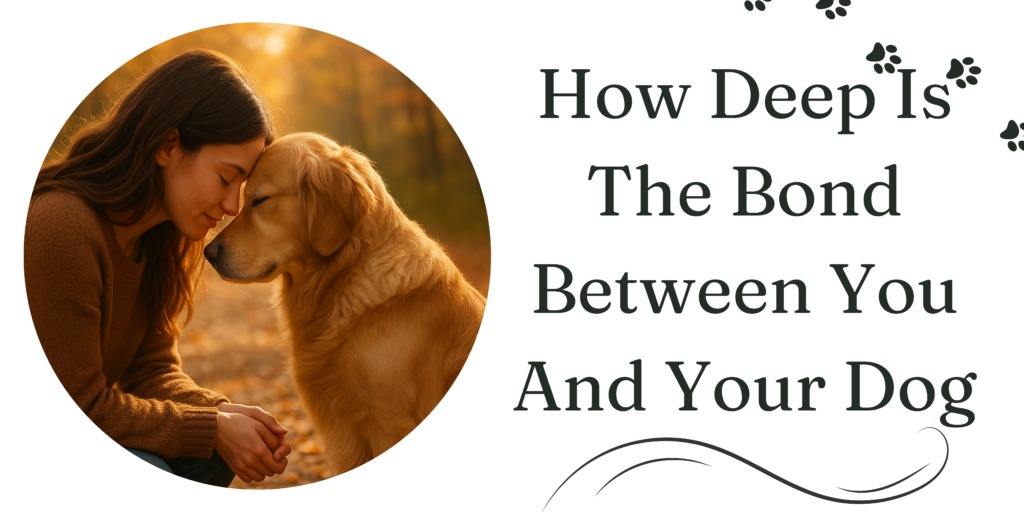
Most dog owners feel it intuitively — a connection that goes beyond feeding and walking. But what does science actually reveal about the dog-human relationship?
For many owners, a dog is not a pet. They are family. This feeling is so common that it is easy to dismiss as sentimentality. Yet decades of research in ethology and comparative psychology confirm what owners have always known: the bond between dogs and humans is real, measurable, and biologically profound — though not always in the ways we imagine.

More Than a Food Dispenser
Early skeptics suggested dogs merely viewed humans as a reliable source of food — a convenient utility, not a social partner. Research has thoroughly dismantled this idea. In a 1996 study, researchers measured the stress hormone cortisol in dogs placed in unfamiliar environments under three conditions: alone, with a companion dog, or with their owner. Dogs left alone showed the highest stress. Dogs with a companion dog showed moderate stress. But dogs with their owner showed significantly lower cortisol — and were more willing to explore the novel space, returning periodically to their owner as a secure base.
The owner’s presence did not just reduce fear. It actively enabled confident exploration — the hallmark of a secure attachment relationship, not a transactional one.

The Strange Situation: Attachment in Action
Human psychologists have long studied parent-child attachment using the “Strange Situation” test. A child is placed in an unfamiliar room with their parent, then briefly left alone, then reunited. Securely attached children explore while the parent is present, show distress when they leave, and recover quickly when they return. Insecurely attached children either fail to seek comfort or remain distressed even after reunion.
In 1998, researchers adapted this test for dogs — and the results were striking. Dogs showed the same behavioral patterns as human children. Securely attached dogs explored the room and played with toys while their owner was present. When the owner left, they became anxious and ignored the stranger. When the owner returned, they greeted them and resumed exploration. Insecurely attached dogs remained clingy or distressed even after reunion.
This is not anthropomorphism. It is convergent evidence that dogs have evolved to form attachment bonds with humans using the same behavioral and neurobiological machinery that binds infants to parents.
The Oxytocin Connection
The biological depth of this bond goes beyond behavior. In 2015, researchers discovered that when dogs and their owners engage in mutual eye contact, both experience a surge in oxytocin — the same hormone that bonds mothers and infants.
Remarkably, this effect is not seen in wolves, even when hand-reared from birth. Wolves avoid prolonged eye contact with humans and do not show the oxytocin feedback loop.
This suggests the oxytocin-gaze loop is not a general canid trait but a domestication-derived adaptation — one that may have been selected for as dogs integrated into human societies.
The Bidirectional Bond
Here is a finding that surprises many owners: your psychology shapes your dog’s attachment. A 2015 study found that owners with anxious attachment styles — those who worry about abandonment and seek excessive reassurance — were significantly more likely to have dogs with separation-related disorders.
The relationship is not just dog-to-human. It flows both ways.
This does not mean anxious owners “cause” separation anxiety. But it does mean that the emotional climate you create — your consistency, your calmness, your ability to provide a secure base — shapes how your dog experiences the world.
What About Trust?
A popular idea holds that dogs follow their owners’ pointing even to an empty bowl, overriding their own knowledge out of blind loyalty. The research tells a different story. When researchers tested whether dogs follow misleading pointing from owners versus strangers, they found dogs were equally misled by both — there was no special owner advantage.
Dogs do show a slight initial preference for following their owner’s pointing gesture on first exposure, but this advantage disappears when both owner and stranger point simultaneously, and it does not override the dog’s own knowledge of where food is hidden.
Dogs follow pointing because they have evolved to read human communicative gestures — not because they suspend critical judgment for their owners.
In fact, dogs are capable of selective trust. When dogs observe that one human consistently points accurately while another points inaccurately, they eventually prefer to follow the reliable informant — a social evaluation skill once thought unique to humans and great apes.
Context Matters
A 2017 study added another layer of nuance: dogs prefer their owners in unfamiliar contexts, but in familiar environments, they may actually allocate more time to a friendly stranger.
Shelter dogs tested with two strangers showed equally strong preferences for one stranger over another. This tells us that the dog-human bond is not fixed and exclusive — it is flexible, context-dependent, and built on positive social interaction rather than rigid loyalty.
What This Means for Your Relationship
The science is clear on several practical points:
1. Your presence is a genuine stress buffer. In novel or stressful situations — vet visits, travel, new environments — your calm presence actively reduces your dog’s physiological stress. Be there.
2. Secure attachment requires a secure base. Just as with children, dogs need to know you are reliable, responsive, and predictable. Inconsistency creates anxiety. Being a steady presence builds confidence.
3. Eye contact is a bonding tool. Mutual gaze is not just “cute.” It triggers a neurochemical bonding cascade. Use soft, relaxed eye contact to strengthen your connection.
4. The bond is co-created. Your emotional state, your attachment style, and your behavior shape your dog’s experience of the relationship. It is not just about what your dog does for you.
5. Dogs are socially savvy, not blindly obedient. They read your cues, evaluate your reliability, and adjust their behavior accordingly. Trust is earned through consistency, not assumed through ownership.
The Bottom Line
The dog-human bond is not a fairy tale or a projection. It is a biologically real, evolutionarily shaped attachment that parallels the parent-child relationship in its behavioral signatures, its neurochemistry, and its psychological consequences. But it is also more nuanced than a simple story of unconditional devotion. It is a dynamic, bidirectional relationship built on communication, consistency, and mutual influence — one that deepens when we understand how our dogs actually experience it.
Sources
Tuber, D.S. et al. (1996) — Behavioural and glucocorticoid responses of adult domestic dogs (Canis familiaris) to companionship and social separation. Journal of Comparative Psychology, 110(1), 103–108.
https://doi.org/10.1037/0735-7036.110.1.103
https://doi.org/10.1037/0735-7036.110.1.103
Topál, J. et al. (1998) — Attachment behavior in dogs (Canis familiaris): a new application of Ainsworth’s (1969) Strange Situation Test. Journal of Comparative Psychology, 112(3), 219–229.
https://doi.org/10.1037/0735-7036.112.3.219
https://doi.org/10.1037/0735-7036.112.3.219
Nagasawa, M. et al. (2015) — Oxytocin-gaze positive loop and the coevolution of human-dog bonds. Science, 348(6232), 333–336.
https://doi.org/10.1126/science.1261022
https://doi.org/10.1126/science.1261022
Konok, V. et al. (2015) — Influence of owners’ attachment style and personality on their dogs’ (Canis familiaris) separation-related disorder. PLoS ONE, 10(2), e0118375.
https://doi.org/10.1371/journal.pone.0118375
https://doi.org/10.1371/journal.pone.0118375
Marshall-Pescini, S. et al. (2011) — Do dogs (Canis lupus familiaris) prefer to be misled more by their owners than by strangers in a food choice task? Journal of Comparative Psychology, 125(4), 456–463.
https://doi.org/10.1037/a0023594
https://doi.org/10.1037/a0023594
Catala, A. et al. (2017) — Dogs don’t always prefer their owners and can quickly form strong preferences for certain strangers over others. Behavioural Processes, 140, 77–84.
https://doi.org/10.1016/j.beproc.2017.04.010
https://doi.org/10.1016/j.beproc.2017.04.010
Petter, M. et al. (2021) — What’s the point? Domestic dogs’ sensitivity to the accuracy of human informants. Animal Cognition, 24, 789–804.
https://doi.org/10.1007/s10071-020-01465-3
Also available at: PMC
https://doi.org/10.1007/s10071-020-01465-3
Also available at: PMC